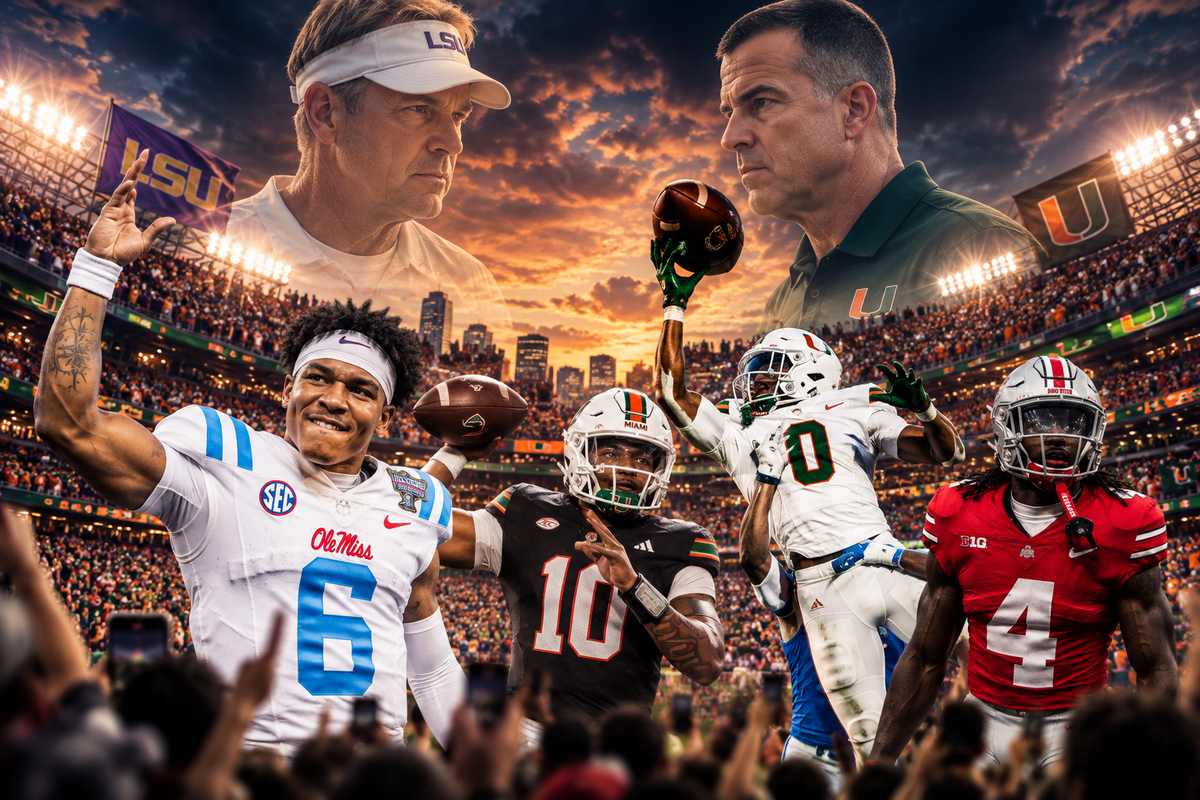
Once upon a time, college football was ruled by traditional powers. Since 1970, powerhouse programs have dominated the sport, building long-lasting dynasties that produced multiple championships and years of sustained success.
In the early 1970s, Nebraska won back-to-back national championships before Oklahoma captured consecutive titles in 1974 and 1975. By the end of the decade, Bear Bryant had Alabama back on top, winning national championships in 1978 and 1979.
Then came Miami.
From 1983 through 1991, the Hurricanes won four national championships under three different head coaches. Miami became the defining program of its era, routinely assembling rosters overflowing with future NFL talent. Florida State followed with one of the greatest stretches of sustained excellence in college football history, finishing in the AP Top 5 for 14 consecutive seasons from 1987 through 2000.
Nebraska dominated the middle of the 1990s, winning three national championships in four years from 1994 through 1997. Miami rose again at the beginning of the new millennium, going 46–4 from 2000 through 2003 and producing a 2001 roster that is still discussed among the most talented teams ever assembled.
USC became the sport's next juggernaut under Pete Carroll. Florida won two national championships in three seasons under Urban Meyer. Then Nick Saban built the greatest dynasty of the modern era at Alabama, winning six national championships between 2009 and 2020.
Clemson eventually emerged as Alabama's primary challenger, winning national championships in 2016 and 2018 and reaching four national championship games in five seasons. Georgia appeared ready to become the sport's next great dynasty after winning consecutive national championships in 2021 and 2022.
But ever since the advent of NIL, the blue bloods no longer have a firm grasp on dynasties. Take last year, for example. A team like Indiana, historically one of the least successful programs in college football, went 16–0 and won the national championship not just because of tremendous coaching, but because the transfer portal and NIL allowed the Hoosiers to amass a veteran-laden team with the best quarterback in the nation.
In 2026, there is no longer a dynastic team like Georgia, Alabama, or Ohio State dominating the landscape, amassing all the best players and hogging all the trophies. Last week alone, one of the biggest spenders in college football, No. 6 Oregon, lost to Oklahoma State—a team that won just one game last season and that Oregon had destroyed 69–3.
Alabama lost to Florida State last year and allowed a Mike Norvell-coached team to put 36 points on them this week. At one point, Bama was down 21–6 before eventually turning it around. No. 12 USC barely got by a bad Rutgers team, while No. 9 Texas A&M labored in Week 2 against the Sun Devils before losing this week to unranked Kentucky. Let's not forget No. 24 Oklahoma, which won just 14–6 against New Mexico this week, or the controversial ending that allowed No. 17 Michigan to escape a massive upset against the Western Michigan Broncos.
As for Georgia, the powerhouse of the 2020s lost to Ole Miss in the playoff last year and is nowhere near the uber-talented teams of the past.
With NIL and the transfer portal, players are making more money than ever before, and the SEC and Big Ten can no longer control the market through bag money and car dealerships. Huge endorsement deals and major corporations are partnering with nontraditional programs in big cities, and players are now making millions of dollars.
For decades, college football's greatest programs had one enormous advantage: they could stockpile talent.
A five-star quarterback could sit behind another five-star quarterback for two years. An NFL-caliber defensive lineman might spend his first two seasons as a rotational player. A talented wide receiver buried fourth on the depth chart had little choice but to wait for his opportunity.
That allowed programs like Miami, Nebraska, USC, and Alabama to build rosters that had tons of talent and wereextraordinarily deep.
Alabama became the ultimate example. During Saban's peak, Alabama was an NFL factory where even the backups were future NFL players. A former five-star recruit could be second or third on the depth chart because the players ahead of him were just as talented.
This new era has brought parity to a sport that had been dominated by blue-blood dynasties, and we are seeing college football transition toward a model similar to the NFL, where the free market is allowing more teams to compete and more upsets to occur.
Even now, big-money spenders like Miami, LSU, Ohio State, Oregon, and the Texas schools can add established players from other programs, but they can also see talented recruits leave for other schools instead of remaining buried on the depth chart.
The rich can still get richer, but they can no longer keep all their riches on the bench.
And that may ultimately be the biggest reason the era of the college football superteam is disappearing.