The Tampa Bay Rays responded to their disappointing Game 1 loss with a much-needed 3-1 victory over the Cleveland Guardians on Tuesday night at Tropicana Field, evening up the American League Championship Series at one game apiece.
After watching Cleveland score seven runs in the series opener, Tampa Bay returned to the formula that helped it win an American League-best 98 games during the regular season: dominant starting pitching, aggressive baserunning, timely hitting, and an outstanding bullpen.
Freddy Peralta delivered six shutout innings, Liam Hicks came through with the biggest hit of the night, and Bryan Baker closed the door in the ninth inning to secure the victory. The Rays also capitalized on a costly defensive mistake by Cleveland superstar José Ramírez, turning what should have been a routine inning-ending groundout into a three-run fourth inning.
The victory ensures that Tampa Bay will head to Cleveland with the series tied rather than facing a daunting 0-2 deficit. With the ALCS now effectively a best-of-five series, the Rays have regained some momentum in their pursuit of the franchise's third World Series appearance.
Here are five major takeaways from Tampa Bay's Game 2 victory.
1. Freddy Peralta Delivers an Ace-Level Performance When the Rays Need It Most
If there was ever a moment for Freddy Peralta to justify Tampa Bay's decision to acquire him at the trade deadline, Game 2 of the ALCS was it.
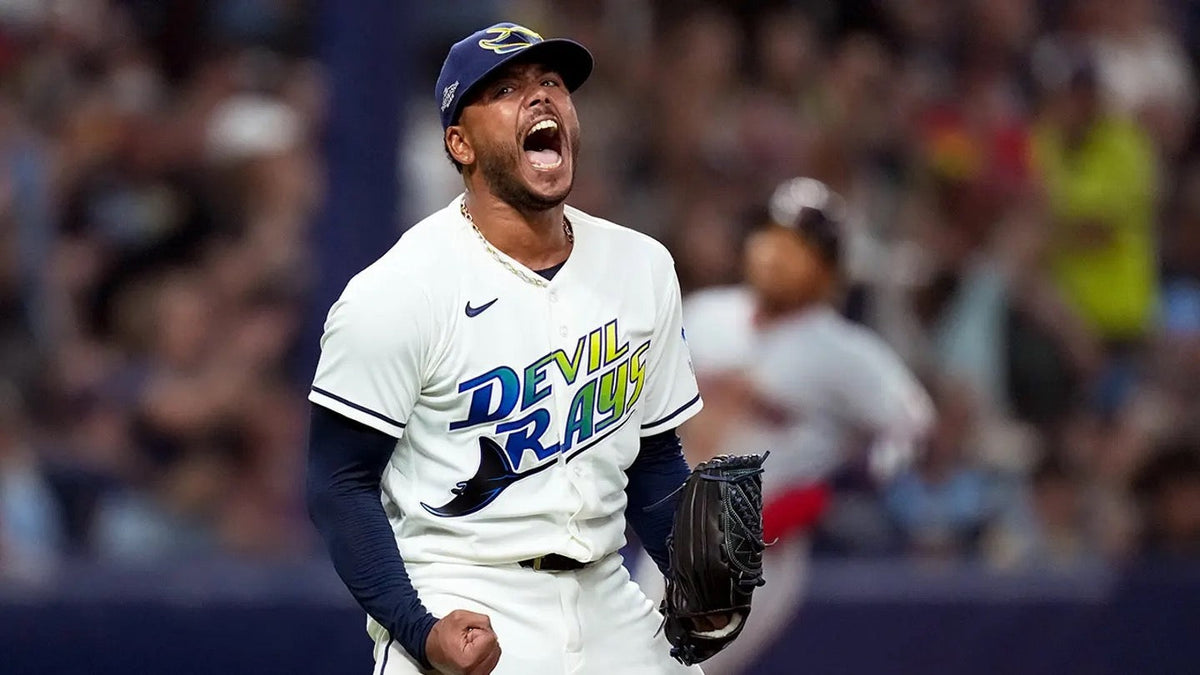
The 30-year-old right-hander delivered one of his finest performances of the season, throwing six scoreless innings while allowing just four hits and two walks and striking out six Cleveland hitters. Peralta needed 99 pitches to complete his outing, but his effectiveness went well beyond the box score.
Perhaps the most remarkable aspect of his performance was his increased velocity. After averaging approximately 94.3 mph with his fastball during the regular season, Peralta reached a career-high 99.4 mph against Jo Adell in the fifth inning and threw 29 pitches exceeding 97 mph.
His ability to elevate his fastball while mixing in a devastating changeup kept Cleveland's hitters off balance throughout the evening.
What makes Peralta's resurgence even more impressive is how dramatically his season has changed since arriving in Tampa Bay. Before being traded by the New York Mets, Peralta had struggled to a 4.99 ERA in 22 starts. His first outing with the Rays was disastrous, as he surrendered seven runs in just 3⅔ innings.
However, Tampa Bay's pitching development staff helped him rediscover the form that once made him an All-Star-caliber pitcher. Over his final nine regular-season starts, Peralta recorded a 2.26 ERA, and his postseason performances have been even more encouraging.
Peralta has now allowed just one earned run across 10⅔ innings in his two postseason starts.
For a Rays team built around pitching, Peralta's emergence as another legitimate ace gives Tampa Bay a significant advantage as the series progresses.
2. Tampa Bay Capitalizes on Cleveland's Costly Defensive Mistake
Postseason baseball is often decided by which team takes advantage of its opponent's mistakes, and the Rays demonstrated exactly why during the fourth inning.
With Tampa Bay threatening against Cleveland starter Parker Messick, Ben Williamson hit what appeared to be a routine ground ball toward third baseman José Ramírez. However, the ball took an awkward hop and slipped past the Guardians' superstar, allowing Victor Mesa Jr. to score the game's opening run.
Instead of escaping the inning without allowing a run, Cleveland suddenly found itself trailing with Tampa Bay threatening to add more.
Liam Hicks made sure the Guardians paid for their mistake, delivering a two-run single to center field that scored Williamson and Chandler Simpson, extending the Rays' lead to 3-0.
That three-run inning ultimately provided all the offense Tampa Bay needed.
The sequence perfectly illustrated the Rays' offensive philosophy. Tampa Bay does not necessarily need multiple home runs or an explosive offensive performance to win games. Instead, Kevin Cash's team uses its speed to pressure opposing defenses, forces opponents to execute routine plays, and capitalizes when those opponents fail.
The Rays finished with only three runs, but their ability to turn one defensive mistake into a decisive inning proved to be the difference.
Against a Cleveland team that has demonstrated an ability to manufacture runs and come from behind, taking advantage of every scoring opportunity will remain essential.
3. Tampa Bay's Trade Deadline Acquisitions Are Paying Off in October
One of the biggest stories surrounding Tampa Bay's postseason run has been the organization's ability to improve its roster without making the blockbuster acquisitions that dominated headlines around Major League Baseball.
While other contenders pursued established stars, the Rays focused on acquiring players who fit their organizational philosophy and could contribute in specific roles.
Two of those acquisitions, Freddy Peralta and Liam Hicks, were arguably the two most important players in Tuesday's victory.
Peralta controlled the game from the mound, while Hicks provided the decisive two-run single that transformed a narrow 1-0 advantage into a three-run lead.
Hicks has proven to be a particularly valuable addition. After arriving in Tampa Bay, the catcher hit .288 with an .819 OPS during the regular season, providing another productive bat in a lineup that relies heavily on contributions throughout the roster.
Although his postseason production had been less consistent entering Game 2, Cash inserted Hicks into the starting lineup against Cleveland left-hander Parker Messick, and the decision paid off.
The success of these acquisitions reflects what has made Tampa Bay one of baseball's most resourceful organizations. Rather than relying exclusively on expensive free agents, the Rays consistently identify undervalued players, develop their abilities, and place them in situations where they can succeed.
Peralta and Hicks are now making major contributions on baseball's biggest stage, demonstrating why Tampa Bay's front office deserves considerable credit for assembling another championship-caliber roster despite operating with one of the league's smallest payrolls.
4. The Rays' Bullpen Continues to Be a Major Strength
While Peralta deservedly received most of the attention for his dominant start, Tampa Bay's bullpen once again demonstrated why it has been such an important part of the team's postseason success.
Cleveland finally broke through in the seventh inning when Chase DeLauter delivered an RBI double, trimming Tampa Bay's advantage to 3-1 and bringing the potential tying run into scoring position.
With the Guardians threatening to turn the game around, Ian Seymour faced Jo Adell, who had delivered a crucial two-run single during Cleveland's Game 1 victory.
Seymour won the confrontation, striking out Adell on a changeup outside the strike zone to end the threat and preserve Tampa Bay's two-run lead.
Kevin Kelly also contributed two important outs as the Rays navigated the late innings.
The game eventually reached the ninth inning, where closer Bryan Baker made quick work of Cleveland's lineup. Baker needed just seven pitches to retire the Guardians in order, securing his fourth save of the postseason.
Baker has now thrown four scoreless innings in the playoffs while converting all four of his save opportunities, building on a regular season in which he posted an outstanding 1.44 ERA.
For a team that frequently plays close, low-scoring games, having a dependable closer and multiple effective relief options is invaluable.
Tampa Bay does not need to score six or seven runs every night when its pitching staff is capable of holding opponents to one or two runs. That ability could ultimately become the difference between reaching the World Series and falling short.
5. The Rays Regain Momentum, but Winning in Cleveland Will Be the Next Challenge
Perhaps the most important takeaway from Game 2 is that Tampa Bay avoided surrendering control of the series before heading on the road.
After losing Game 1 by a 7-3 score, another defeat at Tropicana Field would have placed the Rays in an extremely difficult position, requiring them to win four of the next five games to advance.
Instead, Tampa Bay responded with the type of disciplined, fundamentally sound baseball that helped the organization finish with the American League's best record.
The victory also restored some of the confidence and energy that appeared to be missing during the latter stages of Game 1.
That confidence was evident when Junior Caminero made an impressive defensive play on a sharply hit line drive by Steven Kwan and celebrated with a Dikembe Mutombo-style finger wag. It was a small moment, but one that reflected a Rays team playing with renewed swagger.
However, the challenge becomes significantly greater as the series shifts to Progressive Field.
Cleveland has already demonstrated its resilience throughout the postseason, including overcoming a 2-0 series deficit against the Chicago White Sox in the ALDS. The Guardians also entered Game 2 having won four consecutive postseason games.
Game 3 is scheduled for Thursday at 6 p.m. ET, with Cleveland expected to start Gavin Williams against a Tampa Bay pitching plan featuring Griffin Jax in a bulk role.
Williams is coming off an impressive performance against Chicago, and the Rays will need to find a way to generate offense against another talented Cleveland starter.
The good news for Tampa Bay is that it has already demonstrated a winning formula. Strong starting pitching, opportunistic offense, reliable defense, and an excellent bullpen carried the Rays through the regular season and into the ALCS.
If they can continue executing that formula, they have every reason to believe they can win this series.