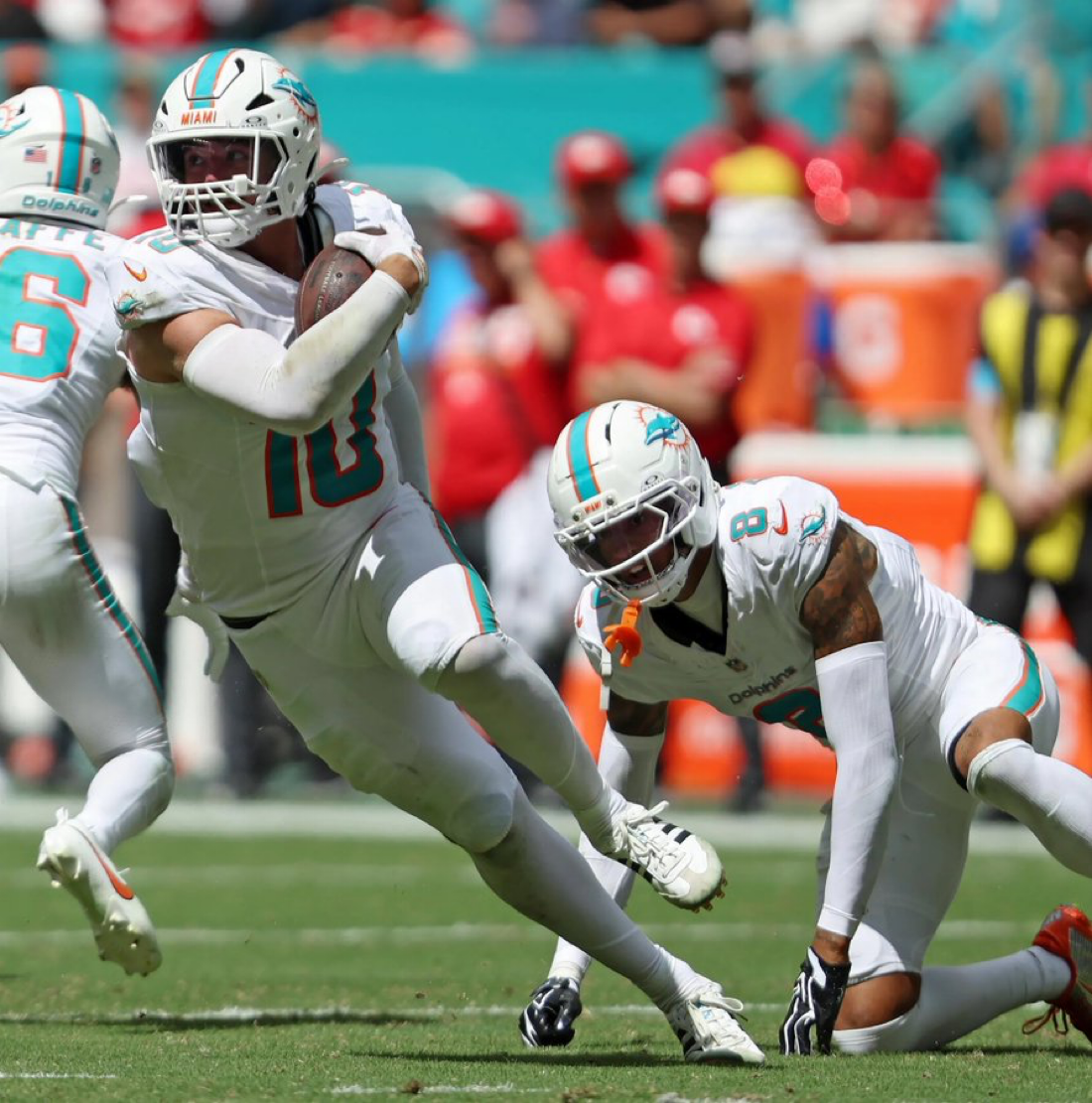
The Miami Dolphins’ nightmare start to the season continued Sunday with a 15–10 loss to the Minnesota Vikings, dropping Miami to 0–4. Unlike some of the Dolphins’ earlier defeats, this was a game that was there for the taking. The defense did enough to give Miami a chance, several members of the rookie class continued to emerge as legitimate building blocks, but the offense once again could not generate enough production to win.
At 0–4, there are plenty of reasons for concern. But perhaps the most frustrating part of Miami’s start is that the Dolphins are beginning to find some legitimate young talent while simultaneously discovering that their current situation at quarterback may prevent them from taking advantage of it.
1. Miami’s Draft Has Been Money
There may not be much to celebrate about an 0–4 start, but Miami’s rookie class is quickly becoming one of the biggest positives of the season.
The Dolphins appear to have found three bona fide starters in Jacob Rodriguez, Chris Johnson and Kadyn Proctor, and all three continued to provide reasons for optimism against Minnesota.
Rodriguez has been nothing short of spectacular.
Through four games, the rookie linebacker leads the entire NFL with 50 tackles, seven more than the player in second place. He also leads the league with 24 defensive stops, six ahead of second place. Those are remarkable numbers for any linebacker, much less a rookie four games into his NFL career.
Against Minnesota, Rodriguez was everywhere, finishing with a monster 19 tackles and nine defensive stops. He is rapidly becoming more than simply a nice rookie story. Rodriguez looks like a player Miami can build its defense around for years to come.
Then there is Chris Johnson.
The rookie cornerback was exceptional again against Minnesota, recording six tackles while playing 44 coverage snaps. He was targeted only four times and surrendered three catches for a grand total of seven yards.
That performance becomes even more impressive when combined with what Johnson did against Kansas City the previous week, when he did not surrender a single reception across 28 coverage snaps.
Cornerback is one of the most difficult positions for a rookie to play in the NFL, yet Johnson already looks comfortable being left in coverage against NFL receivers. It is still early, but he is beginning to look like a potential lockdown No. 1 cornerback for the Dolphins.
Kadyn Proctor’s development has been a little more complicated, but his trajectory is encouraging.
Proctor struggled badly in pass protection to begin the season, posting a 39.1 pass-blocking grade against San Francisco. Since then, however, the improvement has been obvious. He followed that performance with a 63.4 against Las Vegas and has now produced consecutive games with a pass-blocking grade above 70, including a season-best 77.5 against Minnesota.
Proctor had allowed seven pressures and one sack through the first three games, so there is still work to be done, but his recent performances suggest the game may already be slowing down for him.
His run blocking has gone in the opposite direction, with grades of 51.0 and 48.6 over the past two games. Some context is necessary, however, because those games have coincided with De’Von Achane being unavailable.
Running backs and offensive linemen do not operate independently. A backup running back who misreads a hole, hesitates behind the line or simply lacks the burst of a starter can allow a defender to disengage from a block earlier, turning what might have been a successful play into a neutral or negative grade for an offensive lineman. That does not absolve Proctor of his mistakes, but it is part of the larger picture when evaluating Miami’s running game.
Overall, Proctor has been a positive.
An 0–4 record makes everything look worse, but Miami may have come out of this draft with three legitimate NFL starters. If Rodriguez, Johnson and Proctor continue developing at this rate, this draft class could eventually be remembered as one of the foundations of Miami’s rebuild.
2. Malik Willis Is Not It at Quarterback
Four games is not an enormous sample size, but we have seen enough to say that Malik Willis has not looked like the answer at quarterback.
Willis is now 0–4 as Miami’s starter, completing 58 of 103 passes for a 56.3 percent completion rate. He has thrown for 712 yards with just one touchdown and two interceptions, producing a 73.0 passer rating while taking 11 sacks.
More concerning than the cumulative numbers is the direction the offense is heading.
Willis threw for 220 yards with an interception in Miami’s 27–13 loss at Las Vegas. He followed that with his best statistical performance of the season against San Francisco, completing enough throws to finish with 197 yards and his only touchdown pass of the season.
Things have deteriorated since then.
Against Kansas City, Willis threw for 210 yards but failed to produce a touchdown and threw another interception in a 24–10 loss. Then came Sunday’s performance against Minnesota: 9-of-17 passing for only 85 yards.
Eighty-five passing yards simply isn't good enough in the modern NFL.
Willis' mobility remains his most dangerous weapon. He has rushed for 112 yards and a touchdown and can occasionally turn a broken play into something positive. But Miami needs more than occasional improvisation from its starting quarterback.
His accuracy has been inconsistent, particularly when defenses generate pressure or bring additional rushers. He has also held onto the football too long at times, contributing to the 11 sacks Miami has surrendered.
There are mitigating circumstances. Miami's offensive line has had problems. The receiving corps is inexperienced. Losing Achane removed arguably the most explosive weapon from the offense.
But franchise quarterbacks are ultimately judged by whether they can elevate the players around them, particularly when everything isn't perfect.
Through four games, Willis hasn't done that.
There was hope that the flashes he showed in limited action with Green Bay—particularly his ability to attack defenses vertically—might translate into a larger role in Miami. So far, they haven't.
The Dolphins don't necessarily need to make a panic move after four games, but they also cannot allow hope to substitute for evidence. Right now, the evidence says Willis is a talented athlete capable of making plays with his legs, but he has not shown that he can consistently operate an NFL passing offense as a starting quarterback.
3. Miami’s Defense Was Good, The Offense Was Not
This is what makes Sunday's loss particularly frustrating.
The Dolphins allowed 15 points.
In today's NFL, if your defense holds an opponent to 15 points, you should have a very good chance of winning the football game. Miami didn't.
The Dolphins scored 10.
That's the bigger story behind the 0–4 record. Miami is beginning to uncover pieces that could become part of its future. Rodriguez looks like a difference-maker at linebacker. Johnson is emerging at cornerback. Proctor is improving in pass protection. The defense just produced a performance that should have been good enough to win.
But none of it matters if Miami cannot score.
The loss of Achane unquestionably changes the offense. He is the type of player who can turn a routine play into a touchdown and forces defenses to account for him on virtually every snap. Without him, Miami needs its quarterback and passing game to compensate.
Instead, the opposite has happened.
Willis throwing for 85 yards meant Miami had almost no margin for error. Long drives became difficult to sustain, explosive passing plays were scarce, and a defense filled with young players was asked to keep the game within reach for four quarters.
They did.
The offense couldn't finish the job.
That creates an interesting situation for the Dolphins going forward because an 0–4 team is usually looking desperately for young players who can become part of the solution. Miami may already have several of them.
The problem is at the most important position on the field.
Four games into the season, Miami's rookie class has provided genuine reasons for optimism. Rodriguez, Johnson and Proctor look like players who belong. The defense showed Sunday that it can keep the Dolphins in football games.
But the NFL is a quarterback league.
Until Miami finds consistent production at that position, performances like Sunday's are going to continue ending the same way: with the defense doing enough to win, the offense failing to capitalize and another loss being added to the standings.
The Dolphins are 0–4, and while their rookies are giving fans a glimpse of a potentially brighter future, the present is becoming increasingly difficult to ignore.